

 +400-8110278

 International Headquarters:
No. 801 Huagang Road, Wujiang Economic and Technological Development Zone, Suzhou City, Jiangsu Province, China
Global Customer Service Center:
Room 1101, Building 7, Phase 2, Nan'an Xindi, Suzhou Industrial Park, Jiangsu Province, China
No.20306 & 20307, 1st Street, 2nd Floor, East No.3 Gate, Zone 2, Yiwu International Trade City, Zhejiang Province, China
3rd Floor, Plaza No. 157, Main Boulevard, Sector C, DHA Phase 6, Lahore, Pakistan
No. 65A Rustaveli Street, Yakasaray District, Tashkent, Uzbekistan
[Juncess Tech] Ad-Free Pure Science Popularization | Are Household Energy Storage Batteries Safe? Understand IP Ratings + Authoritative Certifications to Avoid Pitfalls!
"Can the battery safety be guaranteed with elderly and children at home?"
"Is there a risk of fire after installing a household energy storage battery?"
"Will it leak and short-circuit on rainy days?"
More and more households and small businesses both domestically and overseas are choosing to install household energy storage systems or small-scale commercial and industrial energy storage to address issues such as high electricity bills, electrical safety concerns, and power outage anxiety. However, "safety" has always been the core concern for everyone. After all, household energy storage batteries are mostly installed in home scenarios such as balconies and garages—once potential safety hazards arise, the consequences can be unimaginable.
Today, we will use plain language to help you understand the safety logic of household energy storage batteries: What exactly are those seemingly professional protection parameters and testing certifications guarding? And how should you choose a qualified household energy storage battery?
First, Master the Basics: What is an IP Rating? Directly Related to Waterproof and Dustproof Safety
When choosing a household energy storage battery, many people encounter parameters like "IP20", "IP54", and "IP65" but don’t know their specific meanings. In fact, the IP Rating (Ingress Protection Rating) is a standard that measures a battery’s ability to resist the intrusion of external foreign objects (dust, solid particles) and liquids (water). It consists of two digits—the higher the number, the stronger the protection capability.
First Digit: Represents Dust Protection Level (Grade 0-6)
Grade 0: No protection; dust can intrude freely.
Grade 2: Prevents the intrusion of solid foreign objects with a diameter greater than 12.5mm (e.g., fingers, large debris).
Grade 5: Dust-protected; dust may enter but not in quantities that affect the battery’s normal operation or damage internal components.
Grade 6: Highest dust protection level; completely prevents dust intrusion, ensuring dust cannot enter and affect battery performance.
Second Digit: Represents Waterproof Protection Level (Grade 0-6)
Grade 0: No protection; not waterproof (corresponds to the waterproof level of IP20, suitable only for dry indoor environments).
Grade 4: Splash-proof; can resist splashing water from any direction (corresponds to the waterproof level of IP54, e.g., daily light rain, sprinkling—suitable for dry, dusty environments with occasional splashes).
Grade 5: Jet-proof; can resist low-pressure water jets from any direction (e.g., daily rain, sprinkling).
Grade 6: Powerful jet-proof; can withstand high-pressure, high-volume water flow impact (e.g., heavy rain, water gun flushing).
For household energy storage batteries, the appropriate protection level should be matched to the installation scenario:
IP20-rated products are suitable for dry indoor environments (e.g., storage rooms, inner balconies without moisture or dust intrusion), meeting the needs of the low-cost, rigid-demand market.
IP65-rated products offer complete dust protection and jet-proof waterproofing, capable of handling semi-outdoor or humid scenarios such as balcony rain exposure, garage humidity, and daily cleaning sprinkling—making them the mainstream choice for most home environments.
For outdoor installations, it is recommended to add additional rainproof protection devices to ensure safe use.
Key Guarantee: 3 Core Safety Tests to Safeguard Against Fire and Explosion
The "fire and explosion prevention" of household energy storage batteries does not rely on merchants’ verbal promises, but on a series of strict safety tests and verifications. Corresponding certifications should also be selected based on the target country or region of sale—there is no need to blindly pursue "full certifications"; the key is to meet local compliance requirements.
The following 3 core tests are "safety exams" that qualified batteries must pass. When choosing a product, you can proactively ask whether the test reports are available.
If a product can cover authoritative certifications from multiple regions, it not only reflects stricter quality control but also adapts to sales needs in different global markets, with a wider scope of application.
1. Thermal Runaway Test: Simulating the Most Extreme Fire Risk
"Thermal runaway" is the most dangerous fault state of lithium batteries—internal short circuits, overcharging, or high-temperature environments can trigger a sharp rise in temperature, leading to fire and explosion. The thermal runaway test actively simulates this extreme scenario to verify the battery’s safety protection capabilities.
Qualified household energy storage batteries respond through "flame-retardant casing+explosion-proof valve+thermal propagation suppression technology":
For example, the casing is made of flame-retardant materials to slow down combustion even if a fire breaks out internally.The explosion-proof valve automatically opens to release pressure when internal pressure is too high, avoiding explosion.Thermal propagation suppression technology prevents the spread of fire from a single cell to the entire battery pack.High-quality household energy storage batteries must pass the thermal runaway test explicitly required by the IEC62619 standard. The relevant test report is a core document proving the product meets safety specifications, minimizing safety risks in extreme situations.
2. Short Circuit/Overcharge/Overdischarge Test: Addressing Daily Misoperations
In daily use, situations such as line short circuits, overcharging caused by charger failures, and overdischarging after complete power depletion may occur—all of which can damage the battery and trigger safety hazards. These tests simulate such scenarios to verify the battery’s "self-protection capabilities."
High-quality household energy storage batteries are equipped with a BMS (Battery Management System), equivalent to the battery’s "intelligent brain":
It instantly cuts off the circuit when a short circuit is detected.It automatically stops charging or discharging when overcharging/overdischarging is detected, avoiding battery damage.Qualified household energy storage batteries must pass the special short circuit, overcharge, and overdischarge tests specified by the IEC62040 standard. The protection performance of the BMS must also meet the requirements of this standard. The corresponding test report is a key basis for verifying the product’s "self-protection capabilities," enabling it to calmly handle various daily misoperations and improve usage safety.
3. Mechanical Shock/Compression Test: Responding to Accidental Collision Scenarios
After installation, household energy storage batteries may encounter accidental situations such as collisions during transportation, scratches when parking in garages, or impacts from falling objects. The mechanical shock/compression test simulates these scenarios to verify the robustness of the battery’s casing and internal structure.
Qualified batteries use high-strength aluminum alloy or steel plates for the casing, with a buffer structure for internal cells. Even if subjected to a certain degree of shock or compression, the cells will not rupture or leak, avoiding safety accidents caused by physical damage.Formal household energy storage batteries must pass the mechanical shock and compression tests specified by standards such as IEC62619 and IEC62477. The test reports must be fully accessible to ensure the product’s casing and internal structure design meet international safety standards, enabling it to cope with accidental collision scenarios during daily transportation and use.
Reassurance Certificate: Recognize Authoritative Certifications to Avoid "Three-No Products"
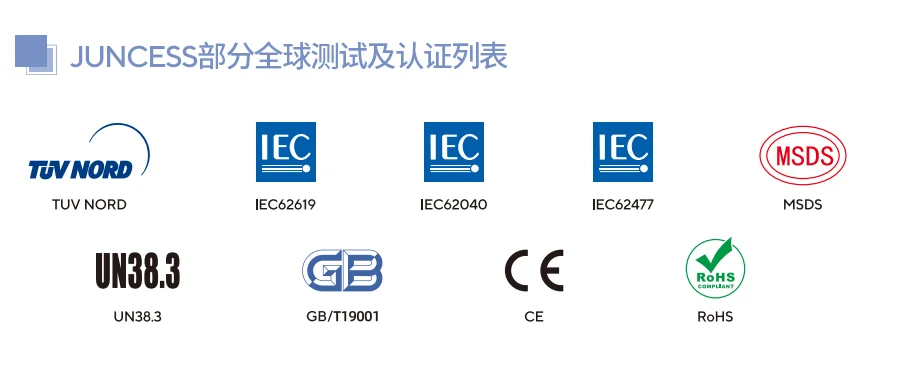
In addition to focusing on protection levels and test items, whether a battery has authoritative certifications is an important basis for judging its safety and compliance. Different countries and regions have different certification standards; common authoritative certifications include:
IEC Certification (International)
Developed and recognized by the International Electrotechnical Commission (IEC), the world’s leading international organization for electrotechnical standardization. Covering most countries and regions globally, its certification is an important document for the export and global sales of household energy storage batteries. Formal products’ IEC certifications are often tested and issued by international authoritative testing institutions such as TÜV Rheinland (North Germany).
GB Certification (China)
Led and developed by the Standardization Administration of the People’s Republic of China (SAC), issued in accordance with national standards. For example, GB/T 36276-2022 "Safety Requirements for Power Batteries for Electric Vehicles" applies to household energy storage batteries sold in China and is the core basis for compliance in the domestic market.
CE Certification (EU)
Issued by EU-recognized third-party certification bodies, it is a mandatory safety certification for products entering the EU market. It must comply with relevant EU safety directives to ensure the safety of products used within the EU.
ROHS Certification (EU)
Issued by EU-recognized institutions, it restricts hazardous substances in electrical and electronic products, ensuring battery products do not contain harmful heavy metals or other prohibited substances and meet environmental safety standards. ROHS certifications for formal products are often issued by EU-recognized institutions such as DEKRA (Germany) to ensure compliance with environmental safety standards.
UL Certification (USA)
Issued by Underwriters Laboratories Inc. (UL), it is a globally recognized safety certification standard. It conducts strict multi-dimensional testing on batteries, including electrical safety, mechanical safety, and environmental safety, and has extremely high recognition in the North American market.
Summary: Remember These 3 Points When Choosing a Safe Household Energy Storage Battery
1、Check the Protection Level:
Choose IP20 for dry indoor environments (meeting low-cost, rigid-demand needs).
Prioritize IP65 for semi-outdoor or humid environments (balconies, garages).
For outdoor installations, pair IP65 products with rainproof protection.
Verify Safety Tests:
Confirm the battery has passed core tests such as thermal runaway, short circuit, and shock tests, with complete test reports available.
Recognize Authoritative Certifications:
Prioritize products with complete authoritative certifications, such as those covering IEC62619, IEC62040, IEC62477, MSDS, GB/T19001, CE, ROHS, UN38.3, etc. Reject "three-no products" (no manufacturer, no certification, no test report).
Choosing a household energy storage battery with authoritative certifications is equivalent to adding a "double insurance" for safety.
However, it is particularly important to note: Certifications must be issued by authoritative institutions. "fake certifications" issued by irregular or unqualified institutions have no legal effect or safety guarantee and may even mislead consumers.
When checking certification documents, it is recommended to verify the qualification of the issuing institution:
For UL certification, confirm it is issued by Underwriters Laboratories Inc.
For IEC certification, prioritize checking if it is tested by international authoritative institutions such as TÜV Rheinland (North Germany).
For ROHS certification, verify if it is issued by EU-recognized institutions such as DEKRA (Germany).
For domestic GB certification, ensure it has the seal of an institution recognized by the Standardization Administration of the People’s Republic of China (SAC).
This avoids purchasing "three-no products" or products with false certifications.
In general, qualified household energy storage batteries must fully pass a number of authoritative certifications and standard tests, such as international core energy storage battery standards including IEC62619, IEC62040, and IEC62477. They must also have compliance documents such as MSDS (Material Safety Data Sheet), CE, and ROHS, and meet UN38.3 air transport safety certification requirements. Products sold in China should also comply with the GB/T19001 quality management system standard to ensure full-link safety and compliance.
If you are unsure which protection level is suitable for your installation scenario, or want to confirm whether an alternative product meets safety standards, feel free to leave a comment telling me your installation environment and needs, and I’ll help you analyze and evaluate!



International Headquarters :
No. 801 Huagang Road, Wujiang Economic and Technological Development Zone, Suzhou City, Jiangsu Province, China
Global Customer Service Center:
Room 1101, Building 7, Phase 2, Nan'an Xindi, Suzhou Industrial Park, Jiangsu Province, China
No.20306 & 20307, 1st Street, 2nd Floor, East No.3 Gate, Zone 2, Yiwu International Trade City, Zhejiang Province, China
3rd Floor, Plaza No. 157, Main Boulevard, Sector C, DHA Phase 6, Lahore, Pakistan
No. 65A Rustaveli Street, Yakasaray District, Tashkent, Uzbekistan
