

 +400-8110278

 International Headquarters:
No. 801 Huagang Road, Wujiang Economic and Technological Development Zone, Suzhou City, Jiangsu Province, China
Global Customer Service Center:
Room 1101, Building 7, Phase 2, Nan'an Xindi, Suzhou Industrial Park, Jiangsu Province, China
No.20306 & 20307, 1st Street, 2nd Floor, East No.3 Gate, Zone 2, Yiwu International Trade City, Zhejiang Province, China
3rd Floor, Plaza No. 157, Main Boulevard, Sector C, DHA Phase 6, Lahore, Pakistan
No. 65A Rustaveli Street, Yakasaray District, Tashkent, Uzbekistan
[Juncess Gatherings] Bridging with Technology, Forging Ahead into the Future — JUNCESS & Tongwei Co., Ltd. Explore the Advancement Path of Distributed PV
Recently, the technical and commercial team of Tongwei Co., Ltd. visited the headquarters of Jiangsu Juncess New Energy (hereinafter referred to as "JUNCESS") and conducted an in-depth technical exchange focusing on "Analysis of Common Customer Complaints in Distributed PV and Prediction of Mainstream Power Rating Development Trends." As a key strategic partner of Tongwei Co., Ltd. in the distributed PV sector, JUNCESS meticulously organized this technical docking event to deepen collaborative innovation between the two parties in product application, project quality, and system reliability, jointly building a high-standard and efficient PV project delivery system.
The event featured Yang Jie, Senior Engineer of East China Region in Tongwei’s PV Business Department, as the keynote speaker. He systematically analyzed typical issues of PV modules during transportation, installation, and operation stages, and deeply interpreted risk prevention and control key points combined with empirical cases. Yang Hua, Senior Business Manager of East China Region in Tongwei’s PV Business Department, delivered a supplementary speech, further elaborating on the collaborative path between product technology iteration and market application.
Core members from JUNCESS’ Marketing Department, Engineering Department, O&M Department, and Project Management Team participated throughout the event. Both parties conducted full interactions on technical difficulties and optimization solutions in actual projects, creating a lively discussion atmosphere and achieving fruitful exchange results.
Through face-to-face technical dialogue and joint case research, the two parties reached a high consensus on key links such as product application standards, project delivery specifications, and O&M response systems. As a professional practitioner in the distributed PV field, JUNCESS has always adhered to technology-driven value and standard-guaranteed quality. This exchange not only reflects the regular technical collaboration between the two parties but also serves as a strong testament to the continuous deepening of their strategic partnership.
1. Looking Ahead: Decoding the Development Trend of Mainstream Power Ratings
At the beginning of the exchange, based on Tongwei’s latest technological R&D progress, Yang Jie prospectively released the power evolution path of industrial & commercial (C&I) and residential distributed products in the next two years. The G12R-66HD and G12-66HD series modules equipped with advanced TNC2.0 technology will become the core products.
Data shows:
The power of the C&I model (TWMNH-66HDG12R) will steadily increase from 630W in Q4 2025 to 645W in Q4 2026;
The universal model for residential and C&I applications (TWMNF-66HDG12) will rise from 725W to a new high of 740W.
This trend indicates that high power, high reliability, and low-voltage design have become the mainstream direction of the distributed market, which helps reduce system Balance of System (BOS) costs and improve overall power station returns.
2. Focusing on Pain Points: In-depth Analysis of Common Customer Complaints in Distributed PV
In addition, the Tongwei team systematically sorted out typical problems that may occur during the full lifecycle of PV modules (including transportation, installation, and operation) around the "common customer complaints in distributed PV" module, and provided intuitive explanations combined with a large number of real-shot cases.
Yang Jie emphasized the importance of the delivery and acceptance link, reminding project parties to verify the quantity and model, check the integrity of the outer packaging during acceptance, and clearly mark abnormal conditions on the acceptance form. Otherwise, it will affect subsequent liability identification and replenishment processing. For common spontaneous module rupture and cracks caused by external impact, he clearly distinguished "spontaneous rupture" (without stress points) from "external damage" (with obvious impact traces) through diagram comparison, and recommended customers to replace damaged modules in a timely manner to prevent leakage or fire risks.
Furthermore, he analyzed more than ten types of issues one by one, including module bending, scratches, junction box yellowing, rainbow spots, color difference, contamination, hot spot causes, reverse connection hazards, and lightning damage. He provided comprehensive and professional solutions covering causes and communication suggestions. It is particularly pointed out that PV modules generate direct current (DC) and do not produce electromagnetic radiation. Their radiation level during operation is much lower than that of mobile phones and household appliances, making them safe for use.
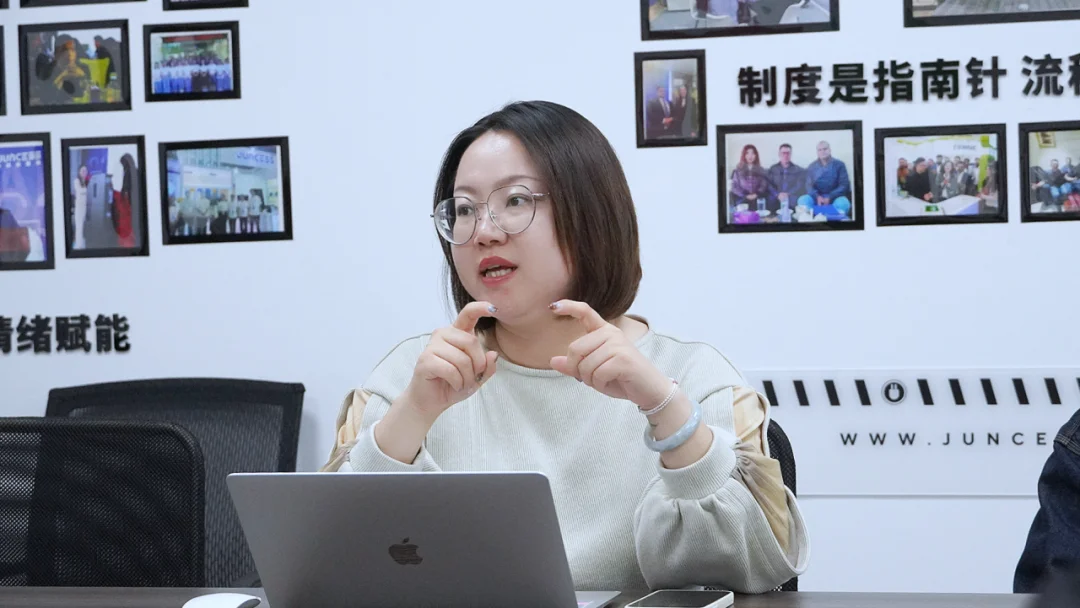
In his supplementary speech, Yang Hua further emphasized that many problems actually stem from negligent details, such as loose bolts, missing gaskets, and insufficient installation spacing. Although seemingly minor, they may lead to serious consequences. He called on all partners to attach importance to standardized construction processes and jointly improve system reliability.
3. Partnering with Strategic Allies to Co-Create a Zero-Carbon Future
This technical exchange has not only significantly enhanced JUNCESS’ team’s professional capabilities in PV module performance understanding, quality risk identification, and system reliability management but also further deepened the collaborative mechanism with Tongwei Co., Ltd. as strategic partners.
Looking forward, JUNCESS will continue to strengthen in-depth cooperation with leading industrial chain enterprises such as Tongwei Co., Ltd. Relying on technical collaboration, information sharing, and joint innovation mechanisms, JUNCESS will continuously make breakthroughs in high-efficiency module application, intelligent system design, and full-lifecycle O&M, jointly creating high-standard distributed PV project benchmarks. We firmly believe that only through open collaboration and professional dedication can we promote the PV and energy storage industry to enter a new stage of more intelligent, safer, and more sustainable high-quality development, contributing solid strength to global energy transition and the achievement of "dual carbon" goals.




International Headquarters :
No. 801 Huagang Road, Wujiang Economic and Technological Development Zone, Suzhou City, Jiangsu Province, China
Global Customer Service Center:
Room 1101, Building 7, Phase 2, Nan'an Xindi, Suzhou Industrial Park, Jiangsu Province, China
No.20306 & 20307, 1st Street, 2nd Floor, East No.3 Gate, Zone 2, Yiwu International Trade City, Zhejiang Province, China
3rd Floor, Plaza No. 157, Main Boulevard, Sector C, DHA Phase 6, Lahore, Pakistan
No. 65A Rustaveli Street, Yakasaray District, Tashkent, Uzbekistan
