

 +400-8110278

 International Headquarters:
No. 801 Huagang Road, Wujiang Economic and Technological Development Zone, Suzhou City, Jiangsu Province, China
Global Customer Service Center:
Room 1101, Building 7, Phase 2, Nan'an Xindi, Suzhou Industrial Park, Jiangsu Province, China
No.20306 & 20307, 1st Street, 2nd Floor, East No.3 Gate, Zone 2, Yiwu International Trade City, Zhejiang Province, China
3rd Floor, Plaza No. 157, Main Boulevard, Sector C, DHA Phase 6, Lahore, Pakistan
No. 65A Rustaveli Street, Yakasaray District, Tashkent, Uzbekistan
How Three-Phase Hybrid Inverters Solve Unbalanced Load Challenges
Three-phase power is widely used in commercial buildings, farms, workshops, warehouses, small factories and other sites with relatively high electricity demand. In theory, a three-phase electrical system works best when the power demand on all three phases is balanced. In real projects, however, loads are rarely distributed evenly.
One phase may carry more air conditioners, lighting circuits, refrigeration equipment or office devices than the others. Another phase may serve pumps, motors or workshop equipment with frequent startup loads. Over time, this imbalance can create operational challenges for conventional inverter systems, especially when the site also includes solar generation, battery storage or backup power equipment.
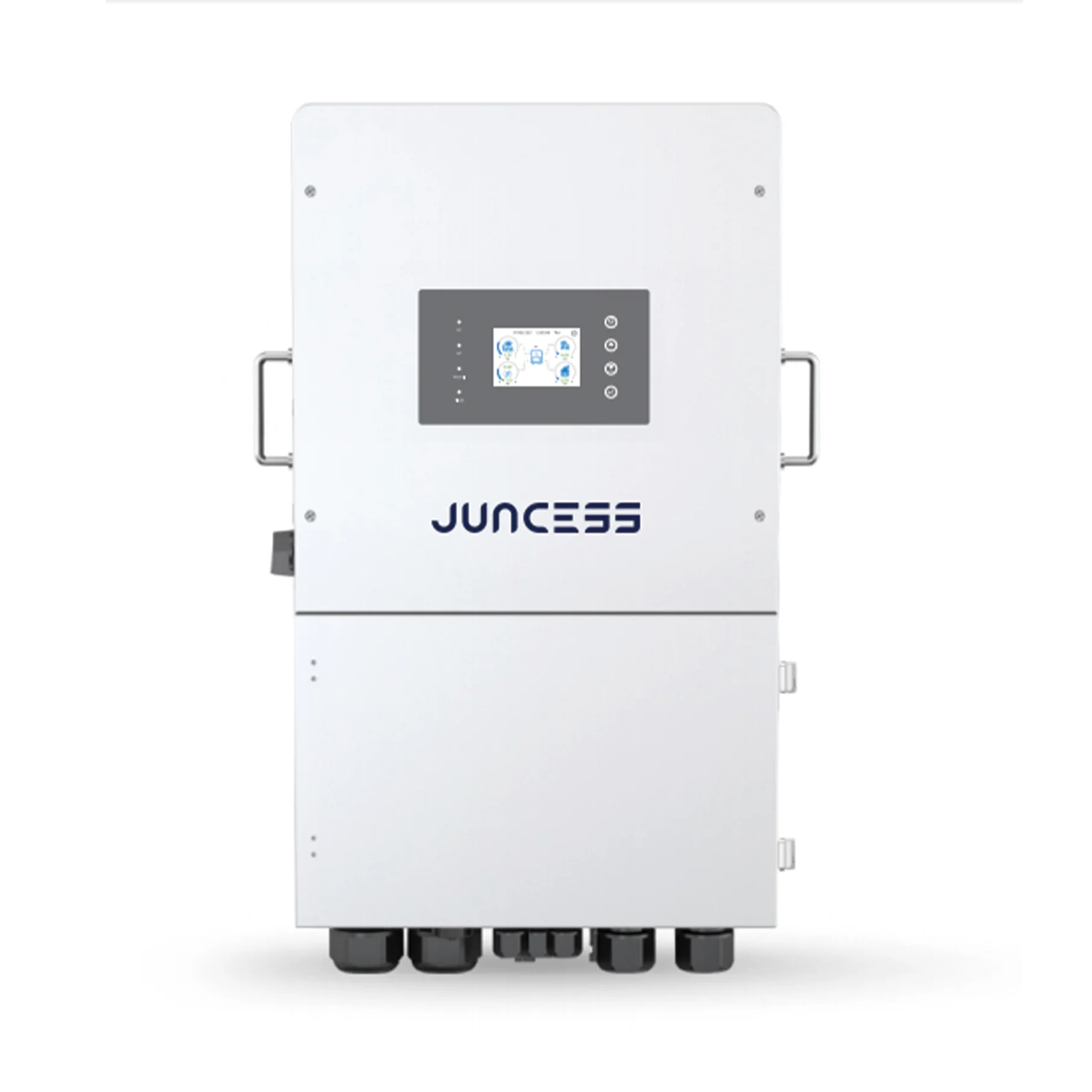
A three-phase hybrid inverter is designed to make this type of energy system more flexible. It can coordinate photovoltaic power, batteries, grid power and backup sources while supporting three-phase loads. For project owners, EPC contractors and installers, the key question is not simply whether a system has three phases. The real question is whether the inverter can handle uneven phase demand without forcing the customer to rebuild the entire electrical distribution structure.
Juncess Energy’s Three-Phase Hybrid Inverter is designed for this kind of practical energy storage application. It supports 100% three-phase unbalanced output, with each phase capable of delivering up to 50% of the rated power. It also supports AC coupling for existing solar system retrofits, parallel operation, multiple battery connections, high charging and discharging current, time-of-use energy scheduling and diesel generator energy storage.
This article explains why unbalanced loads matter, how a three-phase hybrid inverter responds to them, and what buyers should consider when planning a solar-plus-storage project.
What Is a Three-Phase Unbalanced Load?
A three-phase system uses three alternating current phases to distribute power more efficiently than a single-phase system. In an ideal setup, the connected load is evenly divided across all three phases. For example, if a site has a total load of 30 kW, each phase would carry approximately 10 kW.
In reality, that balance is often difficult to maintain.
A small commercial property may have refrigeration units connected mainly to one phase, lighting circuits on another, and office equipment or air-conditioning units on the third. A farm may operate pumps, fans and processing equipment at different times. A workshop may add or remove machines as production requirements change.
This creates an unbalanced load condition. One phase may draw significantly more power than the other two phases, even though the total system load is still within the rated capacity of the site.
Traditional three-phase inverter systems may have limitations when managing these situations. Some systems require phase loads to remain closely balanced. If one phase is overloaded while the others are lightly loaded, the system may reduce output, trigger protection measures or fail to supply the expected power to the most heavily loaded phase.
For users, that means the available battery energy or solar power may not be used as effectively as expected.
Why Unbalanced Loads Are a Real Challenge in Solar-Storage Projects
When solar and battery storage are added to an existing commercial or industrial electrical system, the installation team must work with the site’s real load distribution. It is not always practical to move circuits, rewire equipment or completely rebalance the electrical panel.
This is especially true for retrofit projects. Many businesses already have a working solar installation, established distribution boards and equipment connected according to historical operating needs. Changing the entire load structure can increase installation time, disrupt operations and create additional engineering costs.
Unbalanced loads can also become more visible after energy storage is installed. During battery discharge, the inverter must supply electricity to active loads. If one phase requires much more power than the others, the system must be capable of responding without unnecessarily limiting the entire project.
This is where a three-phase hybrid inverter with true unbalanced output capability becomes important.
How 100% Three-Phase Unbalanced Output Helps
Juncess Energy’s Three-Phase Hybrid Inverter supports 100% three-phase unbalanced output. Each phase can deliver up to 50% of the inverter’s rated power.
In practical terms, this gives the system greater flexibility when different phases carry different levels of demand. Instead of requiring every phase to operate at exactly the same load level, the inverter can respond to uneven power requirements within its operating design.
This can be useful in applications such as:
Small commercial buildings with mixed lighting, refrigeration and office loads
Workshops where some machines operate only on specific phases
Farms with pumps, ventilation equipment and processing devices
Warehouses with security systems, loading equipment and office areas
Retail sites with refrigeration, point-of-sale equipment and air conditioning
Existing solar projects that need battery storage without major electrical redesign
For example, a site may have one phase supporting a group of refrigeration units while the other two phases mainly supply lighting and office equipment. During a power interruption or battery discharge period, the refrigeration phase may need more available output. An inverter that can manage phase imbalance more effectively gives the project more operational flexibility.
This does not eliminate the need for proper electrical design. Installers should still assess the site’s load profile, breaker configuration, cable sizing and phase distribution. However, the inverter’s unbalanced output capability can reduce unnecessary restrictions caused by uneven load behavior.
Retrofitting Existing Solar Systems Through AC Coupling
Many businesses already have photovoltaic systems installed but do not yet have battery storage. In these cases, replacing the complete solar system is rarely the preferred option. Project owners usually want to preserve existing PV equipment while adding storage capability to improve self-consumption, backup power and energy scheduling.
The Juncess Three-Phase Hybrid Inverter supports AC coupling to retrofit existing solar systems. AC coupling allows an energy storage system to be added alongside an existing grid-connected solar installation without requiring the original PV inverter to be removed.
This can be a practical option for sites that already have functioning solar generation but need to address new energy demands, such as:
Reducing dependence on grid electricity during peak periods
Storing excess solar energy for later use
Supporting essential loads during grid instability
Improving the utilization of existing PV generation
Adding backup capability without rebuilding the full solar system
In a typical retrofit project, the existing solar inverter continues to generate electricity. The hybrid inverter works with the battery system to manage energy flow according to site conditions. Depending on the configuration and local grid rules, solar energy can support on-site loads, charge batteries or reduce the site’s grid demand.
The actual design should always be confirmed by qualified engineers based on the local electrical code, grid connection rules and the original solar system configuration.
Parallel Operation for Projects That Need to Grow
Energy demand changes. A commercial site may add new equipment. A workshop may expand production. A farm may install additional pumps or processing machinery. For this reason, scalability is an important consideration when selecting a three-phase hybrid inverter.
The Juncess Three-Phase Hybrid Inverter supports up to 10 units in parallel for both on-grid and off-grid operation. It also supports multiple batteries in parallel.
This gives project developers and installers more flexibility when designing systems for different load levels. Instead of selecting an oversized system from the beginning, a project can be designed with future expansion in mind.
Parallel operation can be useful in several situations:
| Application Need | How Parallel Operation Can Help |
|---|---|
| Growing commercial load | Additional inverter capacity can be added as demand increases |
| Larger battery requirement | Multiple battery units can support longer backup time |
| Off-grid expansion | The power system can scale as more loads are added |
| Multi-building projects | Capacity planning can be adjusted by phase or building section |
| Hybrid power projects | Solar, battery and generator inputs can be coordinated in a larger system |
For buyers, it is important to ask about parallel communication requirements, battery matching rules, installation spacing and system commissioning procedures. Parallel capability is valuable, but it must be designed correctly from the beginning.
Why 48V Low-Voltage Battery Design Matters
The inverter uses a 48V low-voltage battery system with transformer isolation design.
Low-voltage battery systems are widely used in residential, small commercial and distributed energy storage applications. They can be easier to integrate in projects where safety, system accessibility and modular battery expansion are important considerations.
Transformer isolation is also relevant in projects where electrical separation and system protection need to be considered carefully. The exact value of transformer isolation depends on the overall project design, but it can support more robust integration between the battery system, inverter and connected loads.
For installers, low-voltage battery architecture can simplify certain system configurations, particularly in projects that use modular battery banks or require future battery expansion.
However, buyers should still confirm battery compatibility, communication protocols, battery management system requirements and maximum parallel battery configuration before finalizing a project design.
High Charging and Discharging Current for Dynamic Loads
The Juncess Three-Phase Hybrid Inverter supports a maximum charging and discharging current of 350A.
High current capability can be important where the system needs to respond more quickly to changing energy conditions. For example, a site may have strong solar generation during the middle of the day, followed by high energy demand in the afternoon or evening. A battery system with appropriate charging capability can capture more available solar energy during the generation period, while adequate discharge capability helps support loads when needed.
This can be especially useful in commercial applications where demand patterns change throughout the day. A warehouse may have higher load during working hours. A retail site may experience evening demand. A farm may use pumps or processing equipment at scheduled times.
The practical benefit is not simply “more current.” The benefit is greater flexibility in how the system stores and releases energy when properly matched with battery capacity, PV generation and site load requirements.
Time-of-Use Energy Scheduling for Better Control
The inverter supports six time periods for battery charging and discharging.
This feature can be useful for users who want to plan energy operation around site schedules, solar generation patterns or local electricity tariffs. For example, a business may choose to charge batteries during periods of high solar output, then discharge them during evening operation or periods of higher grid demand.
A time-based energy strategy may include:
Charging from solar power during daylight hours
Charging from the grid during lower-demand periods, where permitted and appropriate
Discharging during peak operational hours
Reserving battery capacity for critical backup loads
Coordinating battery use with generator operation
The best schedule depends on local electricity pricing, solar generation, battery capacity and site operating hours. The six time-period function provides more control than a simple charge-and-discharge cycle, allowing users to build a more deliberate energy management plan.
Storing Energy from Diesel Generators
Diesel generators remain widely used in areas with weak grids, remote locations or critical backup requirements. However, generators do not always operate at their most efficient level when serving small or fluctuating loads. In some projects, the generator may run longer than necessary because the site needs occasional power rather than continuous high output.
The Juncess Three-Phase Hybrid Inverter supports storing energy from a diesel generator. This creates an opportunity to combine generator power with battery storage.
In a suitable system design, the generator can charge the battery when it is operating, and the battery can later supply loads when generator operation is not required. This can help create a more flexible power structure for sites such as farms, remote commercial facilities, telecom locations, construction support areas and weak-grid industrial sites.
The system should still be designed carefully. Generator size, battery capacity, inverter configuration, load profile and operating schedule all need to be considered. But combining generator power with battery storage can reduce the need to run the generator continuously for low-load periods.
Choosing the Right Three-Phase Hybrid Inverter Solution
Before selecting a three-phase hybrid inverter, project owners should review more than the rated power. A practical evaluation should include:
Load distribution across phases
Identify whether one phase regularly carries more demand than the others.Existing solar configuration
Confirm whether AC coupling is needed for a retrofit project.Battery system requirements
Check battery voltage, capacity, communication protocol and expansion plans.Backup power priorities
Decide which loads must remain powered during an outage.Future expansion needs
Consider whether parallel inverter and battery operation will be needed later.Generator integration
Review whether diesel generator charging will be part of the project.Energy scheduling goals
Determine how charging and discharging periods should align with solar generation and load demand.
A supplier should be able to provide product documentation, electrical parameters, installation guidance and system configuration support. A three-phase hybrid inverter should be selected as part of a complete energy solution, not as an isolated device.
Conclusion
Unbalanced loads are common in real commercial, agricultural and industrial electrical systems. They should not be ignored when planning solar-plus-storage or backup power projects.
A three-phase hybrid inverter with unbalanced output capability can provide more flexibility by supporting uneven demand across phases. With AC coupling for existing solar retrofits, parallel operation for future capacity growth, 48V low-voltage battery compatibility, high charging and discharging current, time-of-use scheduling and diesel generator energy storage support, the Juncess Three-Phase Hybrid Inverter is designed for practical hybrid energy applications.
For project owners and installers, the goal is not only to install solar and batteries. The goal is to create an energy system that fits the site’s actual loads, supports future development and continues to operate reliably under changing conditions.




International Headquarters :
No. 801 Huagang Road, Wujiang Economic and Technological Development Zone, Suzhou City, Jiangsu Province, China
Global Customer Service Center:
Room 1101, Building 7, Phase 2, Nan'an Xindi, Suzhou Industrial Park, Jiangsu Province, China
No.20306 & 20307, 1st Street, 2nd Floor, East No.3 Gate, Zone 2, Yiwu International Trade City, Zhejiang Province, China
3rd Floor, Plaza No. 157, Main Boulevard, Sector C, DHA Phase 6, Lahore, Pakistan
No. 65A Rustaveli Street, Yakasaray District, Tashkent, Uzbekistan
