

 +400-8110278

 International Headquarters:
No. 801 Huagang Road, Wujiang Economic and Technological Development Zone, Suzhou City, Jiangsu Province, China
Global Customer Service Center:
Room 1101, Building 7, Phase 2, Nan'an Xindi, Suzhou Industrial Park, Jiangsu Province, China
No.20306 & 20307, 1st Street, 2nd Floor, East No.3 Gate, Zone 2, Yiwu International Trade City, Zhejiang Province, China
3rd Floor, Plaza No. 157, Main Boulevard, Sector C, DHA Phase 6, Lahore, Pakistan
No. 65A Rustaveli Street, Yakasaray District, Tashkent, Uzbekistan
How to Choose a Residential Solar + Energy Storage System Tailored to Your Real Household Scenarios
Stuck at the "inverter selection" step when installing a residential solar-storage system? In fact, the inverter is the "heart" of the solar-storage system, responsible for regulating and converting electric energy, and different types correspond to completely different usage demands. Today we will introduce the core differences between grid-tied, off-grid and hybrid types, to help you accurately match the solution to your household scenario.
Grid-Tied Inverter
It only connects the PV panels and the power grid. The electricity generated by PV panels is prioritized for household use, and the excess power is directly fed into the grid (you can get revenue from selling electricity). When the grid fails, the system will automatically shut down and cannot supply power. To put it simply: the system works only when the grid is available.
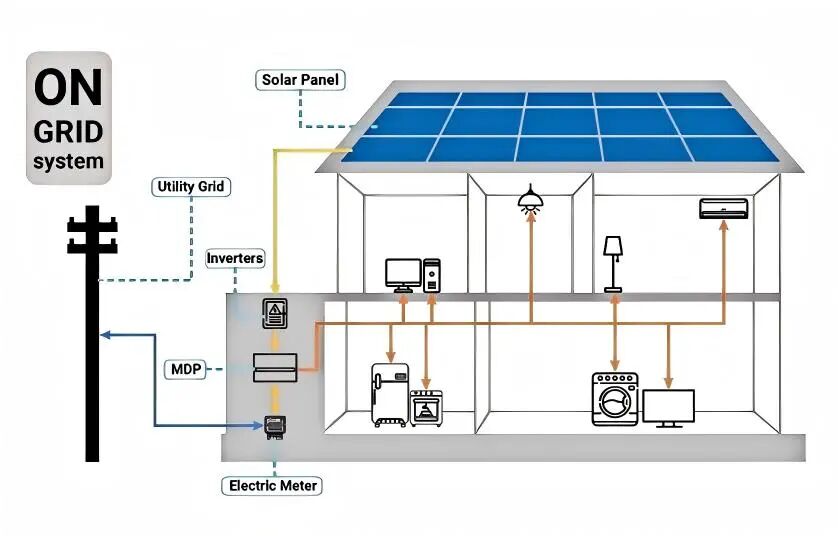
Advantages: Simple structure, lowest cost and easy maintenance. It is suitable for households with core demands of "saving money and improving self-consumption rate". No extra large-capacity energy storage is required, delivering extremely high cost-effectiveness.
Disadvantages: Fully dependent on the grid. To protect grid maintenance workers and prevent islanding effect, ordinary grid-tied inverters will be forced to shut down during power outages. You cannot get power even under strong sunlight, which means the system stops immediately with no emergency backup power function.
The revenue from selling electricity is greatly affected by local policies, and the grid connection process is relatively complicated in some regions. "Self-consumption first, excess power to grid" is the current mainstream mode. The higher the self-consumption ratio, the faster the cost recovery.
Off-Grid Inverter
It does not connect to the grid, and forms an independent power supply system only through PV panels and energy storage batteries. The electricity generated by PV panels is prioritized to be stored in the battery, which then supplies power for the household. It operates completely off the grid, equivalent to a "household exclusive micro power station".
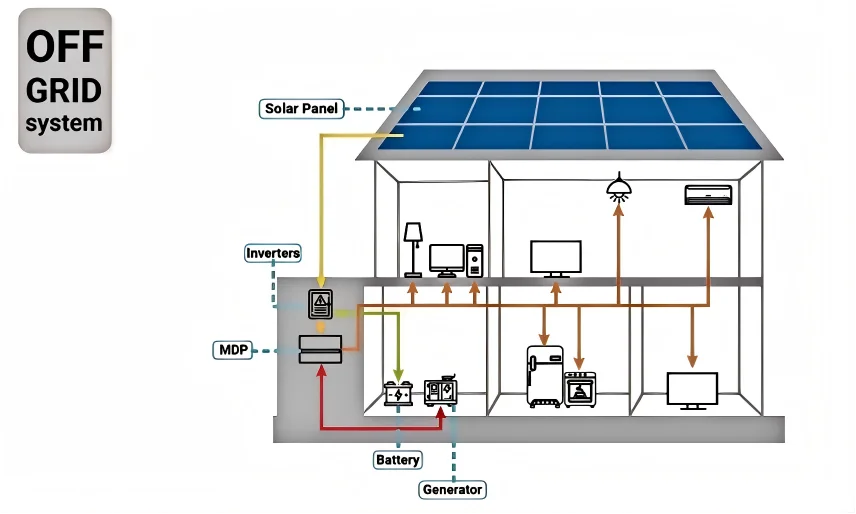
Advantages: Completely realize energy self-sufficiency, free from grid outages and electricity price fluctuations. It is suitable for areas with no grid coverage or extremely unstable grid, delivering top-level power supply reliability.
Disadvantages: The system design is complex, requiring precise matching of power consumption loads. There is a risk of power exhaustion when PV generation is insufficient, and you can additionally configure backup power sources such as diesel generators.
Hybrid Inverter
It integrates both grid-tied and off-grid functions, making it the most mainstream all-in-one solution at present. When the grid is normal, it follows the same "self-consumption first, excess power to grid" rule as the grid-tied type. When the grid fails, it automatically switches to off-grid mode, and the energy storage battery continues to supply power to achieve "seamless connection". High-quality inverters can complete the switching within 10-20 milliseconds, which is critical for keeping computers and refrigerators running without power interruption.
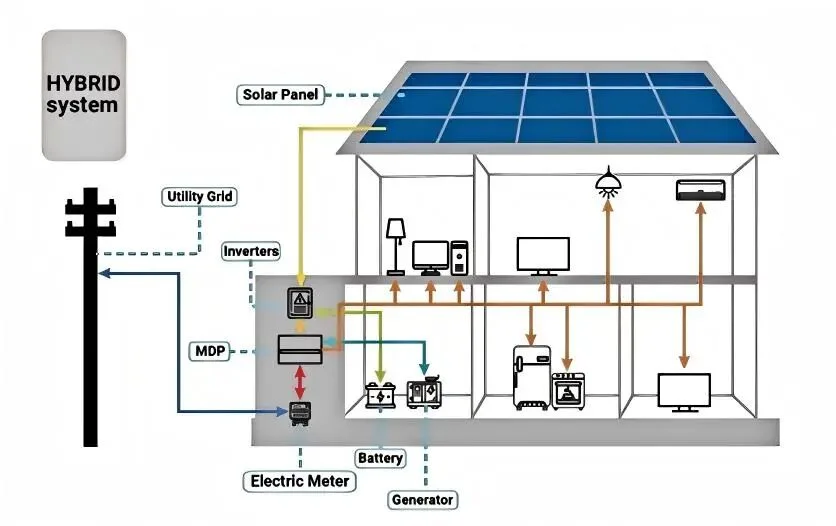
Advantages: Full-featured, it not only meets the demand of saving money, but also copes with power outage emergencies. It can flexibly adjust the ratio of "self-use, energy storage and grid feed-in" to adapt to the power consumption habits of different households. It also has strong future scalability, supporting the expansion of energy storage capacity or PV power.
Disadvantages: The cost is higher than that of the pure grid-tied type, with slightly higher technical complexity. You need to choose a reliable brand to ensure the switching stability.
Key Selection Guidelines
If the annual power outage probability is less than 1-2 times and you have no special backup power demand, the grid-tied type is the most cost-effective choice. If power outages are frequent or you pursue full power supply freedom, directly choose the hybrid type (the optimal solution for most urban households at present).
If the local grid is stable and you have no backup power demand, there is no need to spend extra money on a hybrid inverter. If you cannot use the grid-tied function at all, choosing a pure off-grid type is more worry-free to avoid redundant functions.
Especially for hybrid inverters, switching speed and stability are critical (high-quality brands can control the switching time at the millisecond level, so that electrical appliances will not lose power). At the same time, make sure the voltage and power of the inverter match those of the PV panels and energy storage batteries, to avoid affecting power generation efficiency. Choosing a solar-storage inverter is essentially selecting "an energy solution that fits your lifestyle".




International Headquarters :
No. 801 Huagang Road, Wujiang Economic and Technological Development Zone, Suzhou City, Jiangsu Province, China
Global Customer Service Center:
Room 1101, Building 7, Phase 2, Nan'an Xindi, Suzhou Industrial Park, Jiangsu Province, China
No.20306 & 20307, 1st Street, 2nd Floor, East No.3 Gate, Zone 2, Yiwu International Trade City, Zhejiang Province, China
3rd Floor, Plaza No. 157, Main Boulevard, Sector C, DHA Phase 6, Lahore, Pakistan
No. 65A Rustaveli Street, Yakasaray District, Tashkent, Uzbekistan
