

 +400-8110278

 International Headquarters:
No. 801 Huagang Road, Wujiang Economic and Technological Development Zone, Suzhou City, Jiangsu Province, China
Global Customer Service Center:
Room 1101, Building 7, Phase 2, Nan'an Xindi, Suzhou Industrial Park, Jiangsu Province, China
No.20306 & 20307, 1st Street, 2nd Floor, East No.3 Gate, Zone 2, Yiwu International Trade City, Zhejiang Province, China
3rd Floor, Plaza No. 157, Main Boulevard, Sector C, DHA Phase 6, Lahore, Pakistan
No. 65A Rustaveli Street, Yakasaray District, Tashkent, Uzbekistan
Hi-MO X10 LR7-72HVD: Evaluating 650–665W Modules for Commercial Rooftops
Commercial rooftop solar projects often have to balance limited installation space, electricity demand, roof loading, and long-term operating performance. For factories, warehouses, and other industrial buildings, selecting a photovoltaic module involves more than comparing the wattage printed on its specification sheet. Project teams also need to consider module efficiency, electrical compatibility, temperature behavior, mechanical loads, and installation logistics.
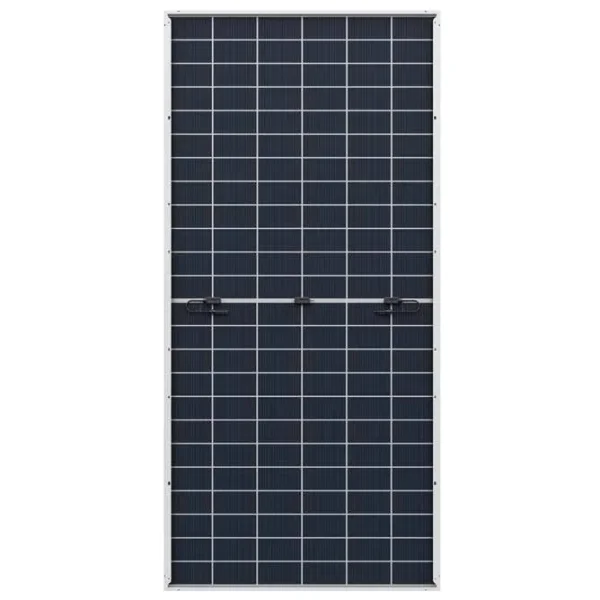
The Hi-MO X10 Scientist LR7-72HVD 650-665M series addresses these considerations with module power ratings from 650W to 665W, conversion efficiency reaching 24.6%, a dual-glass structure, and bifacial power generation capability. Designed for distribution markets and identified as suitable for industrial and commercial cement roofs as well as high-temperature scenarios, this series offers several technical factors worth evaluating before specifying modules for a rooftop project.
Why Module Power and Efficiency Matter on Commercial Roofs
Commercial roofs rarely provide unlimited usable space. HVAC equipment, ventilation outlets, maintenance walkways, skylights, and fire-access routes can all reduce the area available for solar installation. In these circumstances, higher module power and efficiency can help project developers make better use of the available roof surface.
The LR7-72HVD series includes four rated power options: 650W, 655W, 660W, and 665W. Their corresponding module efficiencies are 24.1%, 24.2%, 24.4%, and 24.6%, respectively, under standard test conditions (STC).
| Module model | Rated power | Module efficiency |
|---|---|---|
| LR7-72HVD-650M | 650W | 24.1% |
| LR7-72HVD-655M | 655W | 24.2% |
| LR7-72HVD-660M | 660W | 24.4% |
| LR7-72HVD-665M | 665W | 24.6% |
For example, a project requiring approximately 100kW of nominal DC capacity would need around 154 modules rated at 650W, compared with 151 modules rated at 665W. These figures represent approximate module-count calculations before system sizing and layout adjustments. The final design must account for the inverter configuration, string requirements, roof geometry, and applicable electrical regulations.
The difference in module count may appear small, but across multiple rooftops or a large industrial site, it can affect array layout, mounting hardware quantities, cable routing, and installation planning. Higher wattage should therefore be evaluated alongside the actual roof layout rather than treated as the only selection criterion.
Comparing the 650W to 665W Options
Choosing between the four power classes requires a closer look at the electrical characteristics. Under STC, the 665W model has an open-circuit voltage (Voc) of 54.52V and a voltage at maximum power (Vmp) of 45.17V. Its short-circuit current (Isc) is 15.38A, while its current at maximum power (Imp) is 14.73A.
By comparison, the 650W model has a Voc of 53.80V, a Vmp of 44.65V, an Isc of 15.25A, and an Imp of 14.56A.
The higher-rated models provide more nominal power per module, but their electrical values must still match the project's inverter and string design. The 665M's higher open-circuit voltage, for example, should be included when calculating the maximum number of modules connected in series. Designers must account for the lowest expected ambient temperature because module voltage rises as temperature falls.
Current ratings also matter when checking inverter input limits, connector compatibility, and protection-device requirements. The series specifies a maximum system voltage of DC 1500V under IEC/UL specifications and a maximum series fuse rating of 30A. These values are important design boundaries, not a substitute for checking the complete system documentation.
For commercial distributors, offering multiple power classes can help accommodate different project requirements. For EPC contractors, the better option is the model that meets the required DC capacity and electrical limits while fitting the available roof area and installation plan.
Understanding STC and NOCT Performance
Rated power is measured under defined laboratory conditions. STC uses an irradiance of 1000W/m², a cell temperature of 25°C, and an AM1.5 solar spectrum. Actual operating conditions vary with sunlight intensity, module temperature, wind, and installation geometry.
The product specifications also provide nominal operating cell temperature (NOCT) performance figures. For the 650M model, maximum power is listed as 484.8W under the stated NOCT conditions, compared with 650W under STC. The 665M model is listed at 506.2W under NOCT, compared with its 665W STC rating.
| Module model | STC maximum power | NOCT maximum power |
|---|---|---|
| LR7-72HVD-650M | 650W | 484.8W |
| LR7-72HVD-655M | 655W | 488.6W |
| LR7-72HVD-660M | 660W | 502.4W |
| LR7-72HVD-665M | 665W | 506.2W |
These values help illustrate why project teams should not use the STC rating alone to forecast operating output. NOCT figures are measured under a different set of test conditions; they are not guarantees of output on a particular commercial roof.
When comparing module options, developers should use consistent assumptions for irradiance, temperature, shading, orientation, and system losses. A project-specific energy simulation provides a more useful estimate of annual production than simply multiplying module wattage by the module count.
Evaluating Performance in High-Temperature Environments
Industrial and commercial rooftops can become hot during periods of strong sunlight, especially where roof surfaces absorb substantial heat and airflow beneath the modules is restricted. Temperature behavior is therefore an important consideration when selecting solar modules for these applications.
The LR7-72HVD series specifies an operating temperature range of -40°C to +85°C and a nominal operating cell temperature of 45±2°C. Its maximum-power temperature coefficient is -0.260%/°C, while the voltage temperature coefficient is -0.200%/°C. The current temperature coefficient is +0.050%/°C.
The negative power temperature coefficient indicates that maximum power generally decreases as cell temperature rises above the reference temperature, all else being equal. For illustration, a 20°C increase in cell temperature above 25°C corresponds to an approximate 5.2% reduction in maximum power based on the stated coefficient. This is a simplified temperature-only calculation, not an annual energy prediction.
Roof design can influence operating conditions. Adequate airflow beneath the modules, appropriate mounting arrangements, and careful consideration of roof obstructions can help project teams manage thermal conditions. Site-specific design should also consider local weather, structural limitations, and maintenance access.
For installations in hot regions, module temperature coefficients should be assessed alongside local irradiance data and the intended mounting configuration. This gives developers a more realistic basis for comparing projected performance.
Bifacial Generation and Rooftop Installation Conditions
The series specifies a bifaciality of 70±5%, allowing the rear side to contribute to energy generation when suitable light reaches it. The actual benefit depends on factors such as rear-side irradiance, mounting height, surrounding surfaces, shading, and the distance between the modules and the roof.
The supplied reference table illustrates rear-side power gains of 5%, 10%, 15%, 20%, and 25%, with corresponding reference maximum-power figures ranging from 677W to 808W based on a 645W front-side reference. These figures are illustrative gain scenarios, not the guaranteed output of every 650–665W model in the series.
On a commercial cement roof, the rear-side contribution should be assessed using the actual roof surface and mounting layout. A close-fitting installation may restrict the amount of light reaching the rear side, while other configurations may provide different conditions. The roof's reflectance and the presence of nearby equipment can also affect results.
Project teams should therefore request a bifacial energy assessment based on the proposed installation rather than applying the highest gain percentage directly to the module's rated power. This distinction is particularly important when comparing projected energy yields across different sites.
Mechanical Design, Safety, and Installation Planning
Electrical performance is only one part of module selection. Commercial projects must also confirm that the modules and mounting system can meet the site's mechanical and environmental requirements.
The Hi-MO X10 LR7-72HVD 650-665M series uses dual glass, with 2.0+2.0mm semi-tempered glass, and an anodized aluminum alloy frame. Each module weighs 33.5kg and measures 2382 × 1134 × 30mm. Its junction box is rated IP68 and incorporates three diodes. Output cables have a cross-sectional area of 4mm², with specified standard lengths and customization options.
The listed maximum static loading is 5400Pa on the front side and 2400Pa on the rear side. The module also has a stated hailstone test condition of 25mm hailstones at 23m/s. These specifications are useful reference points, but they do not replace project-specific structural calculations or local building-code checks.
Before installation, contractors should verify roof load capacity, wind uplift requirements, mounting compatibility, drainage, access routes, and safe handling procedures. Module dimensions and weight should be included in transport and lifting plans, especially on roofs with restricted access.
The series lists a Class II protection class and fire ratings of UL Type 29 and IEC Class C. Procurement teams should confirm the applicable certificates and documentation for the target market and intended installation. Product specifications, mounting instructions, and local regulatory requirements should be reviewed together before construction begins.
Using the 30-Year Power Warranty in Project Evaluation
Long-term performance commitments can be an important part of commercial solar procurement because rooftop installations are often planned for decades of operation. The supplied warranty figures for this series state a power level of 98% in year one, 95.89% in year ten, 92.39% in year twenty, and 88.85% in year thirty.
| Warranty milestone | Stated power level |
|---|---|
| Year 1 | 98% |
| Year 10 | 95.89% |
| Year 20 | 92.39% |
| Year 30 | 88.85% |
These figures provide a basis for understanding the stated long-term power warranty. However, a warranty power level is not the same as guaranteed annual electricity generation. Actual energy production is also affected by weather, shading, soiling, degradation mechanisms, system downtime, inverter performance, and maintenance.
Before placing an order, buyers should review the full warranty document, including the applicable product models, degradation terms, exclusions, and claim procedures. Long-term project financial models should use realistic production assumptions and distinguish warranted module performance from forecast system output.
Working with a Supplier on Commercial Rooftop Projects
For distributors and EPC contractors, a successful procurement process includes more than selecting a module with the appropriate power rating. Buyers also need consistent product documentation, dependable shipment coordination, and support with project-specific requirements.
Jiangsu Juncess Energy Co., Ltd. brings 11 years of expertise in the new energy sector and has developed an international business network with more than 400 long-term strategic partners. Its market presence spans Asia, Europe, Africa, the Middle East, and Australia, with established operations in markets including Pakistan and Uzbekistan and expansion plans targeting West Africa.
The company has also expanded from photovoltaic module trading into energy storage, with stated production capacity of 1.5GWh. Its business focuses on integrating photovoltaic and energy storage technologies into broader energy solutions. For customers planning commercial rooftop projects, this background can be relevant when evaluating suppliers for module sourcing and potential solar-storage integration.
Before confirming an order, buyers should provide the supplier with the project location, required DC capacity, preferred module rating, delivery schedule, applicable certification requirements, and installation conditions. It is also useful to confirm the exact model code, packaging configuration, cable requirements, and documentation available for the destination market.
Making a Practical Module Selection
The 650W to 665W range offers commercial project teams several options for balancing module count, conversion efficiency, electrical design, and installation constraints. The most suitable choice depends on the roof layout, inverter specifications, local temperatures, mechanical requirements, and the project's energy-generation objectives.
The Hi-MO X10 LR7-72HVD series combines power ratings up to 665W, efficiency up to 24.6%, bifacial capability, dual-glass construction, and a stated 30-year power warranty. These characteristics make it worth evaluating for industrial and commercial rooftop applications, particularly where roof area and long-term operation are central to project planning.
For a reliable decision, compare the full electrical specifications, review the warranty terms, assess the expected rear-side contribution, and confirm that the mounting and inverter designs satisfy project requirements. Working with Jiangsu Juncess Energy Co., Ltd. can help buyers clarify model selection and sourcing requirements before finalizing a commercial rooftop solar order.
When evaluating modules for your next project, consider the complete set of technical and installation factors rather than selecting by wattage alone. A well-matched Hi-MO X10 LR7-72HVD 650-665M configuration can provide a sound starting point for planning a commercial rooftop PV system.




International Headquarters :
No. 801 Huagang Road, Wujiang Economic and Technological Development Zone, Suzhou City, Jiangsu Province, China
Global Customer Service Center:
Room 1101, Building 7, Phase 2, Nan'an Xindi, Suzhou Industrial Park, Jiangsu Province, China
No.20306 & 20307, 1st Street, 2nd Floor, East No.3 Gate, Zone 2, Yiwu International Trade City, Zhejiang Province, China
3rd Floor, Plaza No. 157, Main Boulevard, Sector C, DHA Phase 6, Lahore, Pakistan
No. 65A Rustaveli Street, Yakasaray District, Tashkent, Uzbekistan
