

 +400-8110278

 International Headquarters:
No. 801 Huagang Road, Wujiang Economic and Technological Development Zone, Suzhou City, Jiangsu Province, China
Global Customer Service Center:
Room 1101, Building 7, Phase 2, Nan'an Xindi, Suzhou Industrial Park, Jiangsu Province, China
No.20306 & 20307, 1st Street, 2nd Floor, East No.3 Gate, Zone 2, Yiwu International Trade City, Zhejiang Province, China
3rd Floor, Plaza No. 157, Main Boulevard, Sector C, DHA Phase 6, Lahore, Pakistan
No. 65A Rustaveli Street, Yakasaray District, Tashkent, Uzbekistan
Wall-Mounted 5kWh Energy Storage Battery: 90% DOD and 6000 Cycles
For residential energy storage, battery capacity is only one part of the selection process. Homeowners and system integrators also need to consider usable energy, cycle life, installation space, operating temperature, monitoring functions, and long-term safety. A battery that performs well in laboratory conditions may not necessarily be convenient for daily home use if it is difficult to install, monitor, or maintain.
The Wall-Mounted5kWh(WIFI/LCD)(Energy Storage Battery) is designed around these practical requirements. Using lithium iron phosphate (LFP) battery technology, the JAL5-T provides 5.22kWh of rated energy, 90% depth of discharge, a 6000-cycle design target, and a compact wall-mounted enclosure. The LCD and WiFi versions also give users different options for monitoring and controlling the battery during everyday operation.
90% DOD Makes More of the Battery Capacity Usable
Depth of discharge is an important specification when evaluating a home energy storage battery. It indicates how much of the battery's stored energy can be discharged during a normal operating cycle.
The JAL5-T has a rated energy of 5.22kWh and a specified depth of discharge of 90%. This means the system is designed to make a substantial portion of its stored energy available for practical household applications rather than requiring a large unused reserve.
For homes using battery storage for emergency loads, this can be particularly useful. Essential circuits may include lighting, communication equipment, refrigerators, networking devices, security equipment, or other selected household loads. The actual backup duration will depend on the power consumption of the connected equipment, inverter efficiency, operating conditions, and system configuration.
The important point is that battery capacity should always be evaluated together with DOD. Two batteries with similar nominal capacities can provide different usable energy depending on their recommended operating range.
LFP Battery Technology for Long-Term Cycling
Battery chemistry has a direct impact on service life, safety characteristics, and operating performance. The JAL5-T uses lithium iron phosphate, commonly known as LFP, and is built with A-grade battery cells.
The specified cycle life is 6000 cycles, providing a suitable foundation for applications that require regular charging and discharging. For a residential energy storage system, this matters because the battery may be cycled frequently as solar energy production and household electricity consumption change throughout the day.
A long cycle life can also reduce the frequency with which the battery system needs to be replaced. However, actual cycle performance depends on factors such as charge and discharge current, temperature, operating conditions, battery management, and the depth of each cycle.
The recommended charge and discharge C-rate for this battery is 0.5C, while the rated charge and discharge current is 50A and the maximum charge and discharge current is 100A. These specifications give system designers useful reference points when matching the battery with an inverter and household load profile.
51.2V and 102Ah: Understanding the Main Electrical Parameters
The JAL5-T has a nominal voltage of 51.2V and a rated capacity of 102Ah, resulting in a rated energy specification of 5.22kWh.
These parameters are important when integrating the battery into a residential energy storage system. Voltage affects compatibility with the selected inverter and other electrical equipment, while ampere-hour capacity describes the battery's electrical charge capacity.
The battery also has a discharge cut-off voltage of 44.8V and a charge limit voltage of 58.4V. These values define important boundaries for battery operation and should be considered when configuring the energy storage system and its control parameters.
The communication protocol supports RS485/CAN, allowing the battery to communicate with compatible system components. Proper communication between the battery and inverter can help coordinate charging, discharging, protection, and battery status management.
Wall-Mounted Design Saves Valuable Installation Space
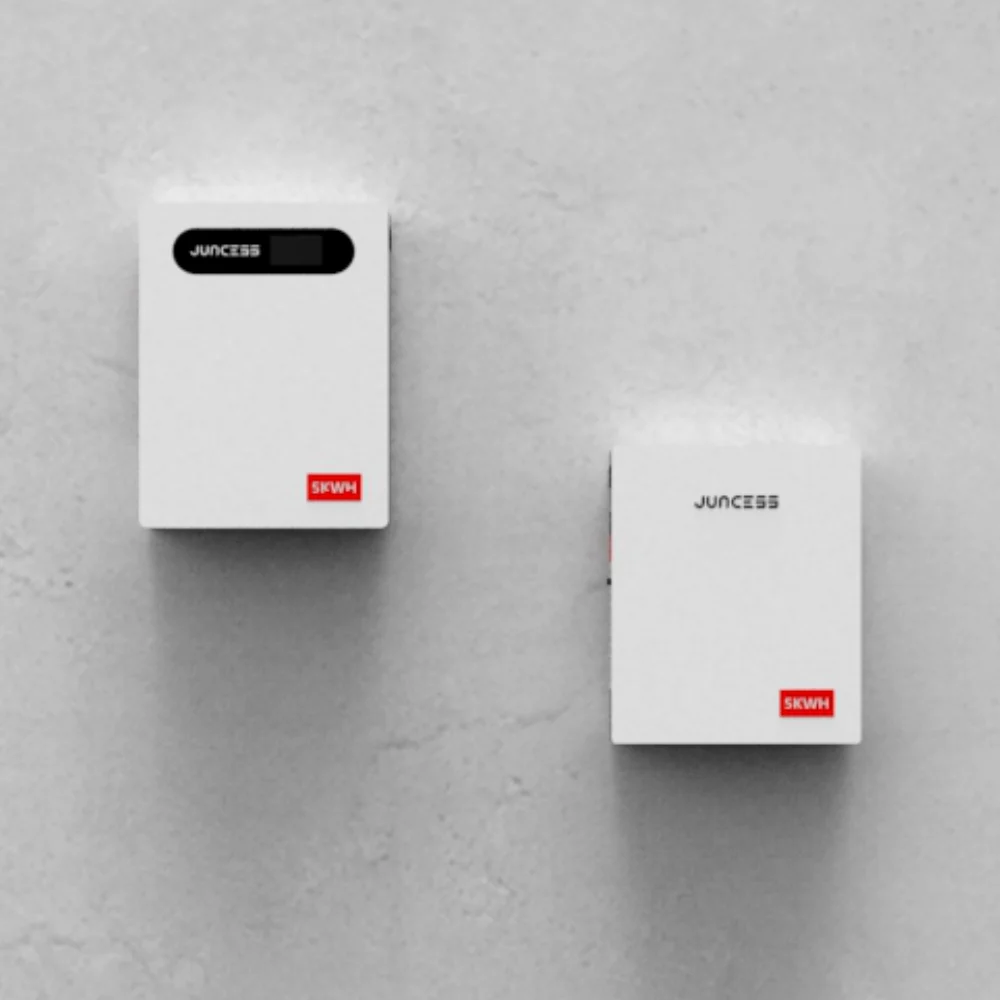
One of the practical advantages of the JAL5-T is its wall-mounted configuration.
Traditional floor-standing energy storage equipment can occupy valuable floor space, which may be inconvenient in smaller utility rooms, garages, storage areas, or other residential installation environments. A wall-mounted battery can make better use of vertical space when the building structure and installation conditions are suitable.
The battery measures 620 × 460 × 134 mm and weighs approximately 46kg. Its relatively slim 134mm depth is useful where installation space is limited, although the wall, mounting hardware, clearance, ventilation, and access requirements should be checked before installation.
For installers, a compact enclosure can also make system planning easier. Instead of reserving a large floor area for the battery, the storage system can be positioned on a suitable wall while leaving floor space available for other equipment.
LCD or WiFi: Two Ways to Monitor the Battery
The JAL5-T is available with different monitoring configurations, giving users a choice based on how they want to manage their energy storage system.
The LCD version provides an intuitive way to view battery operating information directly from the unit. This can be useful for users who prefer local access to basic battery status without relying on a mobile application.
The WiFi version focuses more on remote monitoring and smart operation. Users can access battery information through a mobile phone, making it easier to check operating status without physically approaching the battery.
This difference can be useful for different types of installations. A homeowner may prefer WiFi monitoring when the battery is installed in a garage or utility area, while an installer or operator may prefer direct LCD information during commissioning and routine inspection.
For system integrators, offering both configurations also makes it easier to match the battery monitoring method to the customer's preferences.
Wide Temperature Range for Different Installation Environments
Residential batteries are not always installed in a perfectly controlled indoor environment. Depending on the building, a battery may be placed in a garage, utility room, equipment room, or other semi-outdoor location.
The JAL5-T is specified for an operating temperature range of -20°C to 55°C. This wide range provides flexibility for different climate conditions, although the actual installation location should still comply with the manufacturer's requirements and local electrical and safety regulations.
The enclosure uses SPCC material, providing a durable external structure for the battery. The system also uses natural cooling, avoiding the need for a dedicated mechanical cooling system under normal operating conditions.
For installers working across different regions, considering temperature, ventilation, humidity, dust, and installation location before commissioning is essential for maintaining stable long-term battery performance.
Safety Features for Residential Energy Storage
Safety is a major consideration when installing an energy storage battery inside or near a home.
The JAL5-T combines LFP battery chemistry with multiple protection-oriented design features. The enclosure has an IP54 protection rating, while the battery uses an SPCC casing and natural cooling system.
The product also incorporates a fire protection system based on Perfluoro-2-methyl-3-pentanone. Together with the battery management and electrical protection design, these features are intended to provide additional protection during operation.
The battery supports a 90% DOD specification while maintaining controlled charging and discharging parameters. The charge and discharge limits, communication protocols, and battery management functions all need to work together as part of the complete energy storage system.
It is also important to distinguish between battery-level safety features and overall system safety. Correct installation, appropriate inverter matching, electrical protection, cable selection, grounding, ventilation, and compliance with local regulations remain essential.
Designed for Home Emergency Loads
One of the most practical uses for a 5kWh-class battery is backup power for selected household loads.
Instead of attempting to power an entire home indefinitely, a properly configured energy storage system can prioritize essential circuits. For example, during a grid outage, the battery may be used to support lighting, a refrigerator, internet equipment, security devices, and other important loads.
The actual backup time depends on the combined power demand. A low-power essential-load configuration can operate considerably longer than a system attempting to supply high-power appliances continuously.
This is where the 5.22kWh capacity and 90% DOD specification become meaningful. System designers can estimate usable energy and compare it with the expected load profile before selecting the final battery quantity and inverter capacity.
A Practical Energy Storage Partner for Global Markets
Jiangsu Juncess Energy Co., Ltd. has 11 years of experience in the new energy sector, with capabilities covering R&D, manufacturing, international channels, and energy storage solutions.
The company has developed a global business network covering Asia, Europe, Africa, the Middle East, and Australia, with more than 400 long-term strategic partners. Its market experience includes Pakistan, Central Asia, Australia, and developing markets in Africa.
Juncess has also expanded from photovoltaic-related business into energy storage, supported by non-standard automated customization capabilities and experience in the new energy industry. Its current energy storage production capacity reaches 1.5 GWh.
For international customers, manufacturing capability is only one part of supplier evaluation. Consistent quality control, product certification, technical support, and the ability to understand different market requirements are equally important when deploying energy storage products across multiple regions.
What to Check Before Installing a 5kWh Wall-Mounted Battery
Before installation, several practical factors should be confirmed.
First, calculate the expected household load and identify which circuits need backup power. Second, check the compatibility between the battery and inverter, including voltage range, communication protocol, current requirements, and control functions.
Third, evaluate the installation location. The wall must be capable of supporting the battery and mounting system, while sufficient clearance should be maintained according to installation requirements. Temperature and environmental conditions should also be considered.
Finally, confirm the required monitoring method. The LCD version is suitable for direct local status viewing, while the WiFi version is more convenient for users who want remote monitoring through a mobile phone.
A properly matched battery system is not simply a matter of choosing the largest capacity. It should be designed around actual household loads, backup priorities, solar generation, inverter specifications, installation conditions, and expected daily cycling.
Making 5kWh Energy Storage More Practical for Homes
A residential battery should provide more than stored energy. It should be practical to install, simple to monitor, capable of regular cycling, and suitable for the environment in which it will operate.
With 5.22kWh of rated energy, 90% DOD, LFP chemistry, A-grade cells, 6000-cycle life, a compact wall-mounted structure, RS485/CAN communication, and LCD or WiFi monitoring options, the Wall-Mounted5kWh(WIFI/LCD)(Energy Storage Battery) is designed for residential energy storage and emergency backup applications.
For system integrators and distributors, these specifications provide a useful starting point for building battery storage solutions around different household load requirements. The combination of compact dimensions, flexible monitoring, wide operating temperature range, and multiple protection features also makes the battery suitable for projects where installation space and daily usability are important.
With its energy storage manufacturing capabilities and international market experience, Jiangsu Juncess Energy Co., Ltd. can support customers looking to develop residential energy storage solutions for different regional markets.
For homeowners, installers, and energy storage distributors evaluating a compact battery for home backup applications, the Wall-Mounted5kWh(WIFI/LCD)(Energy Storage Battery) offers a practical combination of usable capacity, long cycle life, monitoring options, and space-efficient installation.




International Headquarters :
No. 801 Huagang Road, Wujiang Economic and Technological Development Zone, Suzhou City, Jiangsu Province, China
Global Customer Service Center:
Room 1101, Building 7, Phase 2, Nan'an Xindi, Suzhou Industrial Park, Jiangsu Province, China
No.20306 & 20307, 1st Street, 2nd Floor, East No.3 Gate, Zone 2, Yiwu International Trade City, Zhejiang Province, China
3rd Floor, Plaza No. 157, Main Boulevard, Sector C, DHA Phase 6, Lahore, Pakistan
No. 65A Rustaveli Street, Yakasaray District, Tashkent, Uzbekistan
