

 +400-8110278

 International Headquarters:
No. 801 Huagang Road, Wujiang Economic and Technological Development Zone, Suzhou City, Jiangsu Province, China
Global Customer Service Center:
Room 1101, Building 7, Phase 2, Nan'an Xindi, Suzhou Industrial Park, Jiangsu Province, China
No.20306 & 20307, 1st Street, 2nd Floor, East No.3 Gate, Zone 2, Yiwu International Trade City, Zhejiang Province, China
3rd Floor, Plaza No. 157, Main Boulevard, Sector C, DHA Phase 6, Lahore, Pakistan
No. 65A Rustaveli Street, Yakasaray District, Tashkent, Uzbekistan
Inside a 16kWh Stacked Low Voltage Energy Storage Battery
Residential energy storage is moving toward systems that are easier to install, expand, monitor, and maintain. For homeowners and installers, battery capacity is only one part of the decision. The physical structure, battery chemistry, protection system, communication options, and long-term operating performance all affect how well an energy storage battery fits a real installation.
The Stacked(Low Voltage)16kWh(Energy Storage Battery) is designed around this practical approach. Based on lithium iron phosphate (LFP) battery technology, the JCL16 provides 16.07kWh of energy with a nominal voltage of 51.2V and a rated capacity of 314Ah. Its stackable architecture allows capacity to be configured in a modular way, while its intelligent safety and monitoring functions support convenient operation in residential and other low-voltage energy storage applications.
A Modular Structure Built for Flexible Capacity
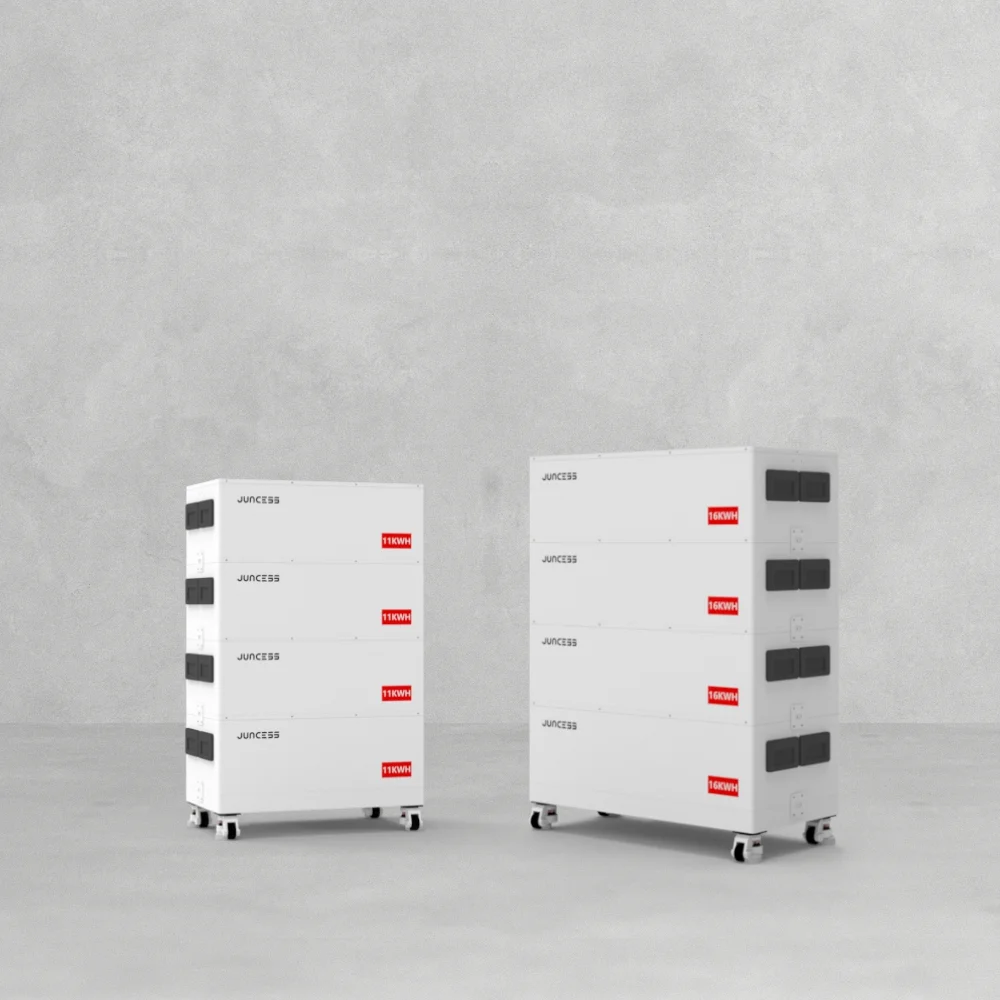
One of the defining features of a stacked battery system is its modular structure. Instead of relying on a single large battery enclosure, the system uses a stackable design that allows battery capacity to be configured according to the actual needs of the installation.
The JCL16 model provides 16.07kWh of energy, while the JCL11 provides 11.77kWh. Both models use a nominal voltage of 51.2V and are based on LFP battery chemistry. This gives installers a choice between two capacity levels while maintaining a consistent low-voltage platform.
The stackable structure also supports plug-and-play expansion. This is particularly useful for residential projects where energy requirements may change over time. A homeowner may initially install a system based on current electricity consumption and later require additional storage capacity as household energy use increases or the solar-storage configuration changes.
The modular approach can also simplify system planning. Rather than selecting an oversized battery from the beginning, installers can work with the available configuration and consider future expansion as part of the overall design.
LFP Technology for Long-Term Battery Operation
Battery chemistry has a direct influence on energy storage performance, safety characteristics, and service life. The JCL11 and JCL16 models use lithium iron phosphate, commonly known as LFP, which is widely used in stationary energy storage applications.
The JCL16 uses Grade A battery cells and is specified with a cycle life of 6,000 cycles and a design life of 10 years. The rated charge and discharge current is 150A, while the maximum charge and discharge current reaches 200A. The recommended charge and discharge rate is 0.5C.
The battery also supports a depth of discharge of 95%. This means the usable capacity can be utilized extensively during normal operation while the battery management system maintains appropriate operating limits.
For a residential energy storage system, these specifications matter because the battery may undergo regular charge and discharge cycles. A system designed for long-term operation needs more than a high nominal capacity; its cells, control system, thermal conditions, and protection functions must work together throughout repeated daily use.
The Stacked(Low Voltage)16kWh(Energy Storage Battery) combines the LFP chemistry with a 6,000-cycle specification to provide a battery platform designed for sustained energy storage use.
Compact Dimensions and Practical Home Installation
Residential battery installation is often constrained by available floor space, access routes, and the location of existing electrical equipment. A battery that delivers substantial capacity but requires excessive installation space may not be suitable for every home.
The JCL16 has dimensions of 866 × 250.5 × 430 mm without its base support. With the base support, the listed dimensions are 866 × 394.5 × 430 mm. Its weight is 128 kg.
Compared with many larger energy storage cabinets, the vertical stacked format makes use of height rather than requiring a wide floor footprint. This can be useful in residential installations where wall and floor space are limited.
The product is also designed with a lightweight-oriented structure for more convenient home installation. Actual handling and installation requirements will naturally depend on site conditions, local regulations, and installer procedures, but the compact form factor can make planning easier when the installation area is carefully selected.
The JCL11 is smaller at 726 × 250.5 × 430 mm and weighs 95 kg, providing another capacity option for installations with lower storage requirements.
Intelligent Monitoring and Energy Management
An energy storage battery is not simply a collection of battery cells. Modern systems need to monitor operating conditions and coordinate charging and discharging according to the requirements of the overall energy system.
The JCL11 and JCL16 support RS485 and CAN communication protocols. These interfaces provide a communication path between the battery and compatible energy management or power conversion equipment.
The system also incorporates remote monitoring and intelligent scheduling functions. For homeowners and system operators, this can provide greater visibility into battery operation without requiring every status check to be performed directly at the battery.
Intelligent energy management can also help coordinate the battery with changing electricity consumption and generation patterns. In a solar-storage application, for example, available solar generation may vary throughout the day, while household electricity demand can change independently. A properly configured energy management system can coordinate battery charging and discharging according to system conditions.
This digital functionality becomes increasingly important as residential energy systems move toward more connected and automated operation.
Protection for Different Operating Conditions
Battery safety is a fundamental consideration in residential energy storage. The JCL16 provides IP54/IP65 protection ratings depending on the configuration, while its specified operating temperature range is -20°C to 55°C.
The IP65 rating can provide protection against dust ingress and water jets under applicable conditions, making enclosure protection an important part of installation planning. However, the exact protection level used should be confirmed for the specific configuration and installation environment.
The battery uses natural cooling rather than a forced cooling system. This avoids the need for an additional active cooling mechanism and keeps the thermal management structure relatively straightforward.
Another important feature is the integrated fire protection system using Perfluoro-2-methyl-3-pentanone, commonly associated with perfluorohexanone-based fire suppression solutions. Combined with intelligent safety management, this adds another layer of protection to the battery system.
These functions should be viewed as part of a complete safety architecture rather than as substitutes for correct installation, electrical protection, ventilation requirements, and professional commissioning.
Built for Residential Energy Storage Applications
The combination of modular capacity, low-voltage architecture, compact dimensions, and intelligent management makes the system suitable for residential energy storage scenarios.
A household with relatively moderate energy storage requirements may use the JCL11, while applications requiring approximately 16kWh of nominal energy can use the JCL16. The ability to work with different capacity configurations gives installers greater flexibility when matching storage to household electricity consumption.
The system can also be considered for homes that already have photovoltaic generation. During periods of higher solar production, surplus electricity can potentially be stored for later use, subject to the configuration of the complete solar-storage system. At other times, stored energy can be used according to the system's operating strategy.
For homeowners, practical considerations extend beyond capacity. Installation space, communication with the inverter or energy management system, environmental conditions, protection requirements, and future expansion should all be included in the project design.
Manufacturing and New Energy Expertise Behind the Product
Jiangsu Juncess Energy Co., Ltd. brings more than 11 years of experience in the new energy sector. The company has developed capabilities covering R&D, manufacturing, sales channels, and integrated energy solutions.
Its business began with photovoltaic module trading and subsequently developed an overseas network covering markets across Asia, Europe, Africa, the Middle East, and Australia. The company has established localized operations in markets including Pakistan and Central Asia, while continuing to expand its presence in emerging markets.
With experience in non-standard automated customization and new energy manufacturing, the company has expanded into energy storage and currently has an energy storage production capacity of 1.5 GWh. Its products have obtained multiple international certifications and have received industry recognition in domestic and overseas markets.
The company also works on the integration of photovoltaic and energy storage technologies, with a focus on digital energy and AI-enabled energy management. This broader technical background provides a foundation for developing storage products that need to operate as part of an integrated energy system rather than as standalone batteries.
A Practical Platform for Long-Term Energy Storage
A residential energy storage battery needs to balance capacity, installation requirements, safety, communication, and long-term performance. The JCL16 addresses these requirements through a combination of 16.07kWh capacity, 51.2V nominal voltage, LFP battery cells, 95% DOD, 6,000-cycle life, and a 10-year design life.
Its stackable architecture adds another practical advantage. Instead of treating storage capacity as a fixed specification, the modular structure allows system designers to consider current requirements and potential future expansion together.
The combination of RS485/CAN communication, remote monitoring, intelligent scheduling, IP protection, natural cooling, and a Perfluoro-2-methyl-3-pentanone fire protection system also makes the product more than a basic battery pack.
For residential projects where installation space, modular expansion, and intelligent energy management are important considerations, the Stacked(Low Voltage)16kWh(Energy Storage Battery) provides a structured low-voltage solution based on LFP technology.
Backed by the manufacturing and new energy capabilities of Jiangsu Juncess Energy Co., Ltd., the product is positioned for energy storage applications that require practical installation, long-term battery performance, and increasingly intelligent system management.




International Headquarters :
No. 801 Huagang Road, Wujiang Economic and Technological Development Zone, Suzhou City, Jiangsu Province, China
Global Customer Service Center:
Room 1101, Building 7, Phase 2, Nan'an Xindi, Suzhou Industrial Park, Jiangsu Province, China
No.20306 & 20307, 1st Street, 2nd Floor, East No.3 Gate, Zone 2, Yiwu International Trade City, Zhejiang Province, China
3rd Floor, Plaza No. 157, Main Boulevard, Sector C, DHA Phase 6, Lahore, Pakistan
No. 65A Rustaveli Street, Yakasaray District, Tashkent, Uzbekistan
